What’s in Dallas Tap Water? A Look at the City’s Water Quality Report
What’s in Dallas Tap Water?
Quick Summary: Dallas’ 2024 Drinking Water Quality Report lists a range of detected substances, including disinfection byproducts, nitrate, trace herbicides and some PFAS, all reported within federal limits. While New York City’s tap water tested exceptionally clean, Dallas’ surface water sources remain vulnerable to agricultural runoff, industrial activity, and aging infrastructure. Culligan of Dallas offers solutions like reverse osmosis, whole-house filtration, and water softeners for families who want to reduce specific contaminants or improve taste at home.
New York City gets credit for some of the best-tasting drinking water in the country. How does Dallas compare? According to Dallas’ own 2024 Drinking Water Quality Report, the city’s water meets federal limits, and the report lists a number of detected substances worth understanding.
Culligan recently put New York City’s tap water under the microscope using its at-home testing kit, checking both for traditional contaminants (like heavy metals and minerals) and so-called “forever chemicals” (PFAS). They tested for 55 different PFAS compounds and found only one: perfluorobutanoic acid (PFBA) at 2.2 parts per trillion, an extremely low level. All 42 of the usual suspects: lead, arsenic, copper, etc., were either undetectable or well below national safety thresholds as set by the U.S. EPA. Culligan’s lab manager concluded that while the levels were low, residents who want extra protection (especially from PFAS) might consider adding a PFAS-specific water filter or reverse osmosis system.
You may be wondering, ‘What about Dallas’s tap water?’ The Dallas Water Utility (DWU) notes that it follows Environmental Protection Agency (EPA) regulations and receives a “Superior” rating from the Texas Commission on Environmental Quality. Meeting standards doesn’t mean water is free of every substance, and the utility reports trace levels of several each year.
Here’s what the Dallas report shows.
Dallas’ water carries a “Superior” rating from TCEQ, and its annual report still lists trace levels of disinfection byproducts, herbicides and some PFAS within federal limits.
Where Dallas’ Water Comes From
Dallas relies on surface water sources including:
- Elm Fork of the Trinity River
- Lake Ray Hubbard
- Lake Lewisville
- Lake Grapevine
- Lake Ray Roberts
- Lake Tawakoni
- Lake Fork
Other reservoirs like Mountain Creek Lake and Lake Worth also play roles in the broader regional system shared with the Fort Worth Water Department.
Because these are surface water reservoirs and not deep ground water aquifers, they are highly vulnerable to contaminants from agriculture, highways, and industry. Runoff from farms, roads and industry can reach surface water supplies like these, which is why they are treated and monitored.
Contaminants Detected in Dallas Tap Water
The Water Quality Information published by DWU lists dozens of contaminants. Some are regulated by the EPA, while others show up under the Unregulated Contaminant Monitoring Rule (UCMR) program. Regulated contaminants each have an enforceable limit set by the EPA.
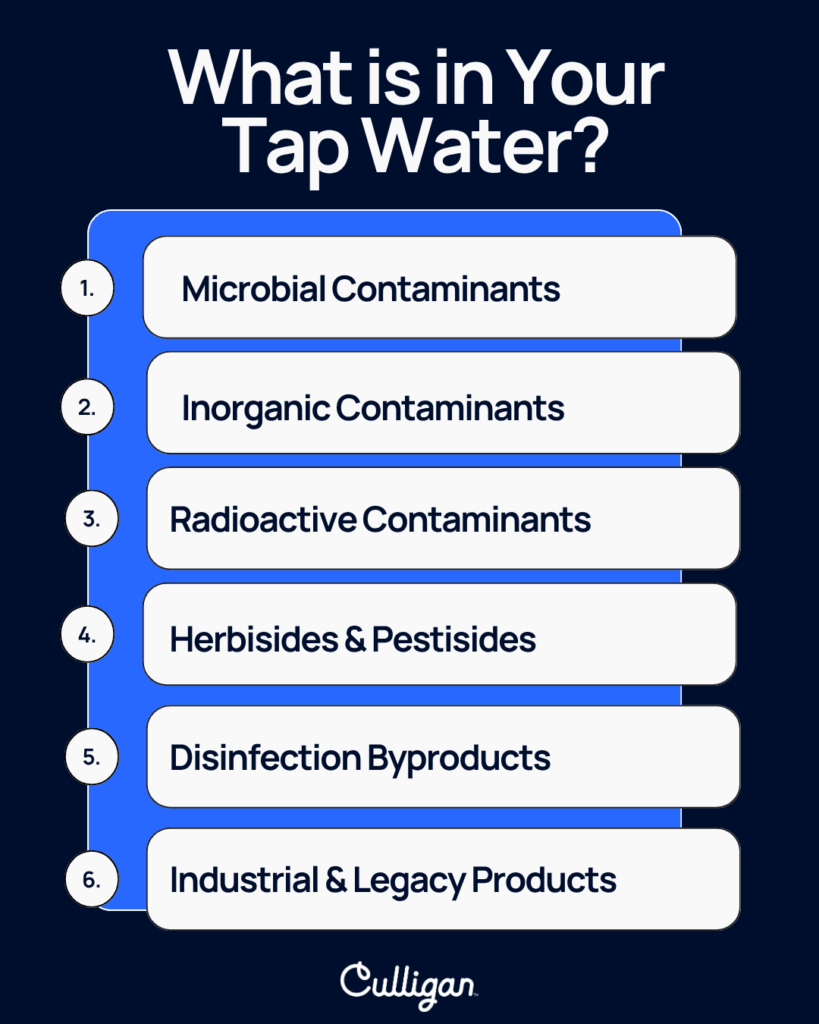
Microbial Contaminants
Dallas monitors for cryptosporidium, a parasite spread through human and animal waste. While not found in treated water, it has been detected in untreated surface water feeding the Trinity River system.
Inorganic Contaminants
- Nitrate: Found up to 1.09 ppm. Comes from fertilizers and sewage.
- Fluoride: Added intentionally, averaging 0.629 ppm.
- Barium, Aluminum, and Mercury: Present from industrial activity.
- Hexavalent Chromium (Chromium-6): Detected at trace levels. The EPA regulates total chromium at 100 ppb; there is no separate federal limit for chromium-6.
Radioactive Contaminants
- Gross Beta Particle Activity: Reported at 6.2 pCi/L, below the EPA’s 50 pCi/L screening level.
Herbicides and Pesticides
- Atrazine and Simazine: Farm herbicides detected in Dallas’ tap water.
Disinfection Byproducts (DBPs)
Chlorine is used in Dallas for chemical treatment, but it reacts with organic matter to form disinfection byproducts, which the EPA regulates (80 ppb for TTHMs and 60 ppb for HAA5):
- Haloacetic Acids (HAA5): Up to 25.8 ppb
- Trihalomethanes (THMs): Up to 25.5 ppb
- Bromochloroacetic Acid: One of the lesser-known DBPs, monitored under the EPA’s Unregulated Contaminant Monitoring Rule.
Industrial & Legacy Chemicals
- Perfluorobutanoic Acid (PFBA), Perfluorobutane Sulfonate (PFBS), and Perfluorooctane Sulfonate (PFOS): All part of the PFAS “forever chemical” family. These chemicals break down very slowly. According to the EPA, studies have linked exposure to certain PFAS to reproductive and developmental effects, an increased risk of some cancers, reduced immune response and increased cholesterol levels. If you have health questions, talk to your doctor.
Why Dallas Water Quality Matters
Federal standards are updated as research develops. In April 2024, for example, the EPA set its first enforceable limits for several PFAS, with compliance phased in over the next several years.
- Your utility’s report reflects water leaving its system, not what reaches your tap.
- Some contaminants, including many PFAS, are still being phased into federal rules.
- Your own plumbing can add lead or copper after water leaves the plant.
Treatment Options From Culligan of Dallas
If you want to reduce specific contaminants or improve taste at home, Culligan of Dallas offers:
- Reverse Osmosis Systems: Can reduce PFAS, nitrate, chromium-6 and lead; check a system’s performance data sheet for what it is certified to reduce.
- Whole-House Filtration: Use activated carbon to reduce chlorine, disinfection byproducts, pesticides, and bad tastes.
- Water Softeners: Reduce scale on fixtures and appliances.
- Water Filters: Point-of-use or whole-home options designed for Dallas’ specific water supply.
Our local team uses Dallas’ annual Drinking Water Quality Report to design solutions tailored to Dallas-Fort Worth families.
Dallas water meets federal standards, and its annual report is the best place to see what was detected. A test of your own tap shows what reaches your fixtures: Culligan’s free in-home test covers hardness, chlorine and other everyday issues, and a certified lab can test for lead, PFAS and other contaminants.